---
title: Mold in Your Mate Gourd? How to Clean It, Prevent It, or Skip It
description: Mold in your mate gourd? Here's how to clean it, how to keep it from coming back, when to toss it, and the gourd-free method I switched to.
image: https://res.cloudinary.com/cekiuehr/image/upload/c_fill,ar_16:9,g_auto,w_1200/f_auto,q_auto/blog/featured/mold-in-your-mate-gourd
---
[Josh Caliguire](https://www.joshcaliguire.com/?hsLang=en)
[Blog](https://www.joshcaliguire.com/blog) [Tea](https://www.joshcaliguire.com/blog) [Friendship](https://www.joshcaliguire.com/blog) [About](https://www.joshcaliguire.com/about?hsLang=en)
[Subscribe](https://www.joshcaliguire.com/contact#newsletter)
Tea
# More Mold in Your Mate Gourd? Let's Talk Alternatives (And What I Do Now)
Josh Caliguire · May 16, 2026

I research and test everything I recommend. As an Amazon Associate, I earn a small commission on purchases through my links. Your price stays the same, and I get to buy more yerba. Win-win.
*Your mate gourd might be kind of gross.*
*It's a dark, musty vacuum, suffering from too much humidity and no proper way to clean it.*
Now before you close the tab... hear me out.
I say this as someone who speaks Spanish, has close friends from Argentina and Chile, and has delighted in sharing with many people. I've passed many a gourd. I've taken the first intense steeping for a homie or two.\*\*\*
And I love this stuff. I love the culture around it. I still make it the traditional way sometimes, and I'll never stop. I still think it is a few notches above coffee in terms of clean energy. [I even did a whole month of just mate, no coffee, to feel the difference.](https://www.joshcaliguire.com/blog/i-switched-my-morning-coffee-with-yerba-mate-heres-what-happened?hsLang=en)
But I've also been experimenting. A lot.
And some of what I've found, I think you'll want to hear, especially if you're experiencing more green and black spots than what you are ready to combat over and over again.
The quick answer: if your gourd has mold, empty it, scrape out what you can, soak it in hot water with a splash of white vinegar, and dry it upside down in the sun. If spots keep coming back or the smell won't leave, replace it. To keep it from happening, empty and rinse the gourd right after every session and let it dry fully open. Or skip the problem with a glass, ceramic or stainless steel cup.
## The Gourd Problem Everyone Runs Into Eventually: Mold
You got a mate gourd. Maybe someone gifted it to you, maybe you ordered it online, maybe you impulse bought it in Argentina and lugged it home in your carry-on. That's certainly the coolest. Either way, you cured it (I hope), you loved it, you used it for a few weeks.
And then life got busy.
And you left the yerba in overnight, or... a few days.
And then... you saw something. Or smelled something. Or both.
Mold in a mate gourd is one of the most searched problems in the entire world of mate. And for good reason. A traditional gourd is made from a dried, fire-hardened squash. It's porous. It absorbs moisture. If you don't dry it out perfectly after every single use, it becomes a science experiment.
People use vinegar, baking soda, salt and lemon, and some of those work! But you're fighting the nature of the material every time.
## How to Clean Mold Out of a Mate Gourd
If you caught it early (a few spots, a musty smell), it's usually saveable. Here's the routine:
1. **Empty it and scrape.** Dump the old yerba and use a small spoon to gently scrape off any visible growth.
2. **Rinse with hot water.** Skip dish soap in a natural gourd. It soaks into the walls and you'll taste it for weeks.
3. **Soak.** Fill it with hot water and a splash of white vinegar and let it sit for 15 to 20 minutes. For stubborn spots, scrub with a paste of baking soda and water.
4. **Dry it completely.** Upside down, somewhere with airflow, ideally in the sun for a few hours. Don't put it back on a shelf until it's bone dry inside.
5. **Re-cure if it was bad.** After a deep clean, curing it again (yerba and warm water left in for a day, then emptied and dried) helps reseal the inside.
When to throw it out: if the mold comes back after a proper clean, if black spots have soaked into the wall, if the smell won't leave, or if the gourd has cracked. At that point you're drinking from the problem every morning.
## How to Keep It From Coming Back
Prevention is all about moisture. Never leave wet yerba in the gourd overnight. Empty it right after your last refill, rinse it with hot water, and dry it upside down with the opening exposed to air. Don't store it with a lid on or in a closed cabinet while it's damp. A little sunlight now and then helps a lot.
To me, the gourd is a high-maintenance vessel for a daily drink. And if you're drinking this thing every morning before you've fully woken up, that's... a lot of responsibility.
## After parting with my molding gourd, I started experimenting.
Even if your gourd is spotless and perfectly cured, there's still the matter of the mate itself.
Yerba mate is not like loose-leaf tea (camellia sinensis). It's not even like coarse coffee grounds. It's a mix of stems, leaves, and a very fine powder... and that powder goes *everywhere*. Into the water. Into the straw. Into your mouth. Into your throat. I got used to it... for the most part.

The bombilla (the metal straw with a built-in filter) is designed for exactly this, and it works pretty well most of the time. But even with a good bombilla and good straw placement, you still get sediment. You still get that slightly gritty coating on the tongue. You still won't get it right every time, which means scoobies.
I know you can 'perfect' your placement with the monte, the way you put the bombilla in. But I'm just looking for a midday work break drink, without the complexity.
I started wondering: what if the mate didn't have to come with a side of dust, or having to use the straw?
## My Filter Experiments (Not All of Them Worked)
I love a clean cup. My coffee rotation involves an AeroPress, a V60 and a Chemex. I'm a paper filter person at heart. Clean, bright, sediment-free. So naturally, I started trying to apply that to mate. (The full ranking of what worked is in [Blog: 4 Ways to Brew Yerba Mate with Coffee Gear You Already Own](https://www.joshcaliguire.com/blog/4-ways-to-brew-yerba-mate-with-the-coffee-gear-you-already-own-ranked?hsLang=en).)
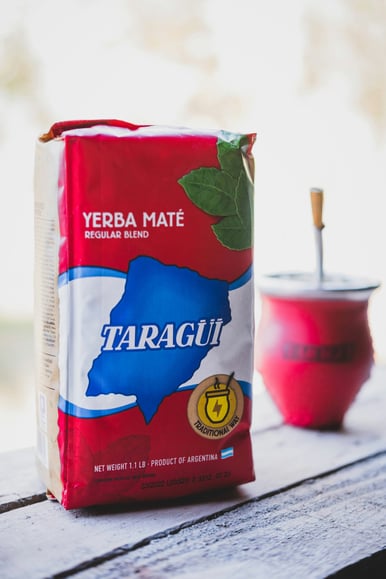
**Coffee pot.** First attempt. Looked promising. Did not work. The powder in mate is so fine that the second it hits water, it coats every pore of the paper. The whole filter seals up. Water just sits there, going nowhere. I stood over it for longer than I'd like to admit, hoping gravity would eventually win. Gravity did not win. And the water? Scalding. Too hot. No control over temperature.
Pour over is technically the same situation... gravity-fed through paper... so same result. It looked cooler and more guaranteed with a 175 degree goose neck kettle making circles. But nothing dripped through.
**French press.** This one felt more promising, because at least you're using pressure. And it worked... sort of. The dust did come through, though, in a way that was still pretty unpleasant. The result was cloudy, almost silty. Like mate-colored water that hadn't fully decided what it wanted to be. The mesh filter in a French press is just too coarse for the job. It keeps out the really big stuff but lets all the fine powder through.
I drank it. I'm not going to pretend I didn't. But it wasn't the clean experience I was after.
## Then I Remembered my AeroPress
I've been using an AeroPress for coffee for years. And one day it just clicked: *this thing uses pressure, not gravity.* That's the whole point of it.
And here's what I found - the pressure helps it come through quickly, but you get the same paper filter experience. What comes out is genuinely clean. No particles, no sediment, no gritty mouthfeel. Just mate. Properly filtered, ready to drink.
It's the same amount of effort as an aeropress of coffee which takes me only 3 minutes. And the result is the cleanest mate I've ever had.
The other thing the AeroPress gives you is control over infusion time, which matters for mate because temperature and steep time are the two main culprits for too much bitterness. With the AeroPress, you can let it steep, watch the clock, and press at exactly the right moment. Not too early, not too late. You decide.
And yes, you can absolutely do multiple infusions. I've gotten three to four solid infusions from a single AeroPress scoop of mate.

[I've written a full breakdown of my AeroPress mate method over here if you want to go deep on technique.](https://www.joshcaliguire.com/blog/yerba-mate-aeropress-the-cleanest-brew-youre-not-making-yet?hsLang=en)
If the taste is the other hurdle, I put everything that's worked for me (lemon, milk, temperature, smoother yerbas) in [Blog: How to Make Yerba Maté Less Bitter](https://www.joshcaliguire.com/blog/how-to-make-yerba-mat%C3%A9-less-bitter?hsLang=en).
## Gourd Alternatives That Can't Grow Mold
If you love your gourd and want to keep using it, that's great...! Here are a couple of things that help: rinse it immediately after every use, let it dry fully upside-down, and don't store it with the lid on or in an enclosed space. Sunlight helps too.
But if you want to sidestep the issue entirely, the easiest solution is switching to a vessel that moisture can't penetrate in the first place. A glass mate cup or a stainless steel mate cup eliminates the mold problem by design... nothing to absorb, nothing to harbor anything over time. There are some genuinely beautiful options out there if you want the ritual of the gourd without the science experiment. I compare gourd materials (calabash, wood, ceramic, glass, stainless) in [Blog: The Best Yerba Mate Gourd and Bombilla](https://www.joshcaliguire.com/blog/the-best-yerba-mate-gourd-and-bombilla?hsLang=en).
And if you're open to leaving the gourd behind entirely? The [AeroPress Go](https://www.amazon.com/dp/B07YVL8SF3?tag=joshcaliguire-20) might be your next step. It produces the cleanest, most controlled cup of mate I've found... and it fits in a bag, works anywhere, and takes a few seconds to clean. Pair it with a thermos and you're set for the day: [Blog: Best Thermos for Drinking Yerba Mate All Day](https://www.joshcaliguire.com/blog/best-thermos-for-yerba-mate?hsLang=en).
## I Still Love This Drink
This is just me being honest about what I've found through a lot of trial and error. I love trying teas and brewing methods from all over the world, and I'm always experimenting. Mate was too good a drink to let the dust situation be the final word.
If you've been discouraged by the mess, the mold, the gritty sips... give yourself permission to try something different. There are a lot of mate purists who say there is only one true way to make it, but I disagree. There is room for creativity. Ask the carbonated, sweetened cans of El Tony Mate from Switzerland. Man that stuff was fun to try on my last trip.
And if you do try the AeroPress method, I'd genuinely love to know what you think.
Let me know how it goes.
- *[I Switched My Morning Coffee with Yerba Mate. Here's What Happened.](https://www.joshcaliguire.com/blog/i-switched-my-morning-coffee-with-yerba-mate-heres-what-happened?hsLang=en)*
- *[Yerba Mate AeroPress: The Cleanest Brew You're Not Making Yet](https://www.joshcaliguire.com/blog/yerba-mate-aeropress-the-cleanest-brew-youre-not-making-yet?hsLang=en)*

About Josh Caliguire
Writer, friend, and community builder splitting time between Mazatlán, Boulder, and Alberta. I write about tea, friendship, and the deliberate small choices that make life richer.
[Subscribe to the newsletter →](https://www.joshcaliguire.com/contact#newsletter)
Keep Reading
## More from the blog
[](https://www.joshcaliguire.com/blog/commercial-tea-brewer?hsLang=en)
Tea
### [Commercial Tea Brewers: How to Choose One for Making Tea at Scale (2026 Guide)](https://www.joshcaliguire.com/blog/commercial-tea-brewer?hsLang=en)
How to choose a commercial tea brewer for a cafe or restaurant: iced vs hot tea, gallons per hour, plumbing, and the BUNN and Zojirushi picks I'd buy.
[](https://www.joshcaliguire.com/blog/tea-shop-equipment-list?hsLang=en)
Tea
### [What Equipment Do You Need to Open a Tea Shop? The 9 Essentials](https://www.joshcaliguire.com/blog/tea-shop-equipment-list?hsLang=en)
What equipment do you need to open a tea shop? The 9 essentials I'd buy first, from hot water boilers and display jars to an iced tea brewer.
[](https://www.joshcaliguire.com/blog/best-water-boiler-for-tea?hsLang=en)
Tea
### [Best Water Boiler for Tea in 2026: Hot Water on Tap for Gong Fu Cha, Green Tea and Hosting](https://www.joshcaliguire.com/blog/best-water-boiler-for-tea?hsLang=en)
The best water boiler for tea holds the right temperature all day. My 5 picks, led by the Zojirushi I've used for years, for gong fu cha, work and hosting.
## Pull Up a Chair
Get my best notes on tea, yerba mate, and friendship in your inbox. No spam, unsubscribe anytime.
Josh Caliguire
Writer, tea lover, and community builder. Exploring friendship, intentional living, and the best cup of the day.
Explore
- [Blog](https://www.joshcaliguire.com/blog?hsLang=en)
- [Tea](https://www.joshcaliguire.com/blog/tag/tea?hsLang=en)
- [Yerba Mate](https://www.joshcaliguire.com/blog/tag/yerba-mate?hsLang=en)
- [Friendship](https://www.joshcaliguire.com/blog/tag/friendship?hsLang=en)
- [About](https://www.joshcaliguire.com/about?hsLang=en)
- [Contact](https://www.joshcaliguire.com/contact?hsLang=en)
Partners
© 2026 Josh Caliguire. Powered by tea, friendship, and midnight oreos and milk.
```json
{
"@context" : "https://schema.org",
"@type" : "BlogPosting",
"author" : {
"@type" : "Person",
"name" : "Josh Caliguire",
"url" : "https://www.joshcaliguire.com/blog/author/josh-caliguire"
},
"dateModified" : "2026-05-23T21:21:49.170Z",
"datePublished" : "2026-05-16T04:50:25.000Z",
"headline" : "Mold in Your Mate Gourd? How to Clean It, Prevent It, or Skip It",
"image" : [ "https://res.cloudinary.com/cekiuehr/image/upload/c_fill,ar_16:9,g_auto,w_1200/f_auto,q_auto/blog/featured/mold-in-your-mate-gourd" ],
"mainEntityOfPage" : {
"@id" : "https://www.joshcaliguire.com/blog/mold-in-your-mate-gourd",
"@type" : "WebPage"
},
"publisher" : {
"@type" : "Organization",
"logo" : {
"@type" : "ImageObject",
"url" : "https://www.joshcaliguire.com/hubfs/josh_caliguire_logo_v4.svg"
}
}
}
```
```json
{
"@context" : "https://schema.org",
"@type" : "BlogPosting",
"articleSection" : "Yerba Mate",
"author" : {
"@type" : "Person",
"name" : "Josh Caliguire",
"url" : "https://www.joshcaliguire.com/about"
},
"dateModified" : "2026-05-16",
"datePublished" : "2026-05-16",
"description" : "Ok, so I broke outside the gourd scene. I tried a pour over, a French press, any cleaner way to brew yerba mate... and the AeroPress won the day. Here's what I found.",
"headline" : "More Mold in Your Mate Gourd? Let's Talk Alternatives (And What I Do Now)",
"image" : "https://www.joshcaliguire.com/hubfs/masha-xK4ND_bhrik-unsplash.jpg",
"inLanguage" : "en-US",
"keywords" : "mold in yerba mate gourd, yerba mate gourd mold, how to clean mate gourd, yerba mate gourd alternatives, aeropress yerba mate, how to brew yerba mate without gourd, yerba mate without bombilla, clean yerba mate brew, yerba mate mold problem, alternative ways to brew yerba mate",
"mainEntityOfPage" : {
"@id" : "https://www.joshcaliguire.com/blog/mold-in-your-mate-gourd",
"@type" : "WebPage"
},
"publisher" : {
"@type" : "Person",
"name" : "Josh Caliguire",
"url" : "https://www.joshcaliguire.com"
},
"url" : "https://www.joshcaliguire.com/blog/mold-in-your-mate-gourd"
}
```